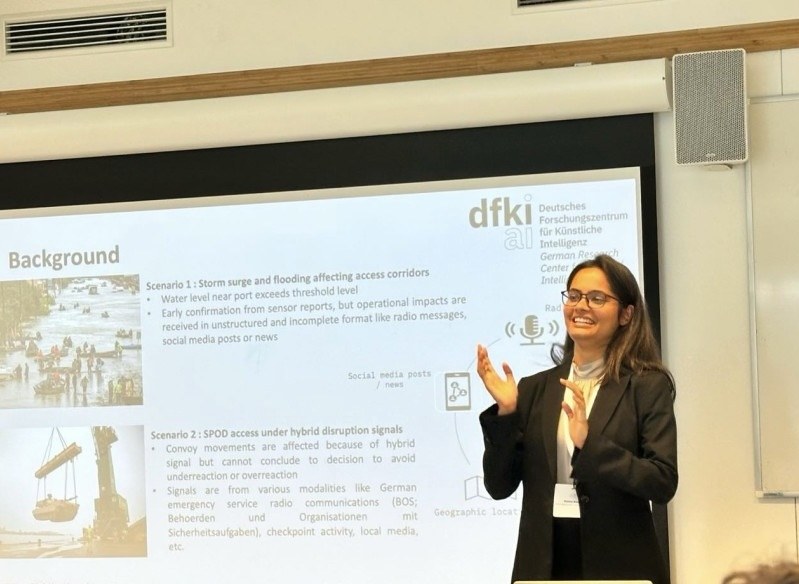
Rishika Kumari presented our research paper at the 23rd International Conference on Information Systems for Crisis Response and Management (ISCRAM 2026), held in The Hague, Netherlands, under the conference theme "Building Stronger Futures: Ensuring Public Safety in Times of Crisis." The conference brought together researchers, practitioners, and policymakers to discuss innovative approaches for improving resilience, crisis management, and emergency response through advanced information systems and artificial intelligence. The paper titled "Multimodal Situational Awareness for Civil-Military Coordination in Port Disruption Scenarios" presents ARGUS, a multimodal situational awareness framework designed to support civil-military coordination during disruptions in complex port environments. Modern crisis response requires the integration of heterogeneous information sources, including hydrological sensor measurements, emergency radio communications, social media reports, and news streams. ARGUS addresses this challenge by fusing diverse multimodal data into unified georeferenced incident representations, enabling improved operational awareness and decision support.
The proposed framework was evaluated using a synthetic Wilhelmshaven port disruption dataset. Experimental results demonstrate that ARGUS significantly reduces operational alert volumes while maintaining high incident detection performance. The presented work further highlights the challenges of spatial matching and incident fusion in dense crisis scenarios, motivating future research on adaptive spatial reasoning and context-aware fusion strategies.
The presentation received positive feedback from the audience, particularly regarding the methodology for spatial incident matching and multimodal data fusion. Discussions emphasized the practical relevance of integrating heterogeneous information sources for enhancing operational decision-making during large-scale emergencies. The conference also provided valuable insights into recent advances in AI-based weather forecasting, early warning systems, graph-based conflict analysis, and resilient logistics, reinforcing the importance of multimodal AI systems for crisis management. The acceptance and presentation of this work demonstrate the growing importance of trustworthy multimodal AI for emergency response and civil-military coordination. The research contributes to the development of intelligent decision-support systems capable of improving situational awareness, reducing information overload, and strengthening operational resilience in complex crisis environments.
Reference:
Janzen, S., Kumari, R. & Maass, W. (2026). Multimodal Situational Awareness for Civil-Military Coordination in Port Disruption Scenarios. In: Proceedings of the 23rd ISCRAM Conference – The Hague, the Netherlands, June 2026.