
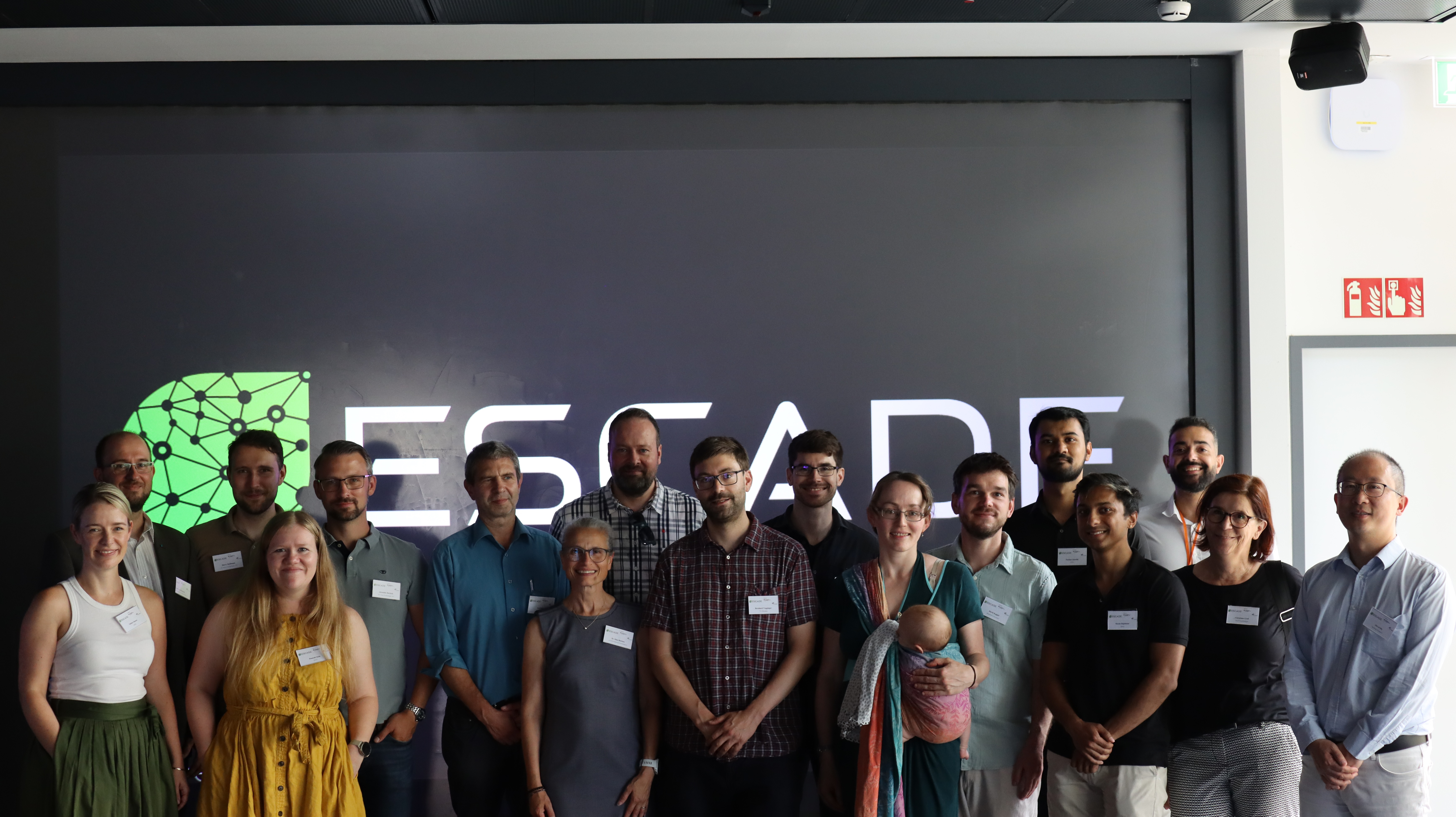
On 30 July 2026, the ESCADE project came to a close with a final event at DFKI in Saarbrücken. More than 50 guests from research, industry and public administration accepted the invitation to see what the consortium coordinated by Prof. Dr.-Ing. Wolfgang Maaß had developed over three years: ways to operate artificial intelligence in data centers at a fraction of today's energy demand.
Opening ceremony
Hannah Stein opened the morning and introduced the project. Greetings followed from Gerald Maruhn, Head of the Digital Policy Division at the Saarland Ministry of Economic Affairs, Innovation, Digital Affairs and Energy, and from Dr. Christiane Graß of the DLR Project Management Agency. Nils Meyersick, Vice President Industrial AI Ecosystem & Business Development at T-Systems, then gave the keynote on scaling AI efficiently and on the tension between energy, cost and data center operations, followed by a talk from SpiNNcloud Systems on energy efficiency at the edge.
Project results tour
The main part of the programme was a guided tour of seven presentation stands, where the project teams showed their results side by side and created room for deeper exchange: energy-efficient visual computing on edge, efficient language models built on biologically inspired algorithms, energy analytics with intelligent GPU frequency adaptation, measurement methodology and benchmarking, the ESCADE simulator together with findings on neuromorphic computing in data centers, exploitation and transfer including the DIN SPEC, and the AI Sustainability Framework. Most stands ran live demonstrators, among them EAVE, the project's open prototype for energy analytics.
Behind these stands are the results the consortium spent three years working towards. Through knowledge distillation, large teacher models are reduced to tailored student models up to 90 percent smaller, which in the project's test runs delivered comparable performance while consuming up to 89 percent less energy. For models that process image data, neural architecture search shrank the networks by almost 90 percent and cut energy consumption by 40 percent, in some cases even improving accuracy. Together with the Stahl-Holding-Saar, a compressed visual model was evaluated in practice, classifying the type of scrap steel delivered to the plant from camera images. A decision-support tool forecasts the energy consumption and operating costs of AI models, so that compute-intensive workloads can be scheduled for periods of low electricity prices. On the hardware side, neuromorphic chips ran up to six times more efficiently than conventional processors in the project's tests.
Because the tour was accompanied by a catered lunch, discussions carried on well beyond the individual stands. The format gave researchers, company representatives and interested visitors time to talk through concrete application scenarios, and the consortium made clear that it is looking for further cooperation to bring the technologies into practice.
ESCADE in the media
The results also resonated well beyond the event itself. In the days around the closing event, the Frankfurter Allgemeine Zeitung, Saarländischer Rundfunk and two Deutschlandfunk podcasts reported on the project, as did Saarland University, the Saarland Informatics Campus and the state innovation agency saaris. The relevant links are listed below.