
Data centers are springing up all over the world – and with them the power plants that feed artificial intelligence's hunger for energy. A research consortium led by Wolfgang Maaß (German Research Center for Artificial Intelligence DFKI and Saarland University) has investigated ways to cut the electricity demand of AI by up to 90 percent using hardware and software technologies. On 30 July, from 10 a.m. to 1 p.m. at DFKI on the Saarbrücken campus (D3 2), the team will present how AI can achieve a better environmental footprint while at the same time giving small and medium-sized enterprises access to high-performance AI models.
Almost everyone uses artificial intelligence in one way or another today. What is not obvious to everyone: even the smallest answer from a chatbot consumes energy and resources. Training and operating AI models with mass data devours hundreds of terawatt hours worldwide. On a global scale, all of this leaves an enormous ecological footprint. And with the rapid development of the technology, demand will rise steeply. New data centers will seal off vast areas of land, as will new – possibly even fossil-fuel – power plants that have to supply the additional energy required. CO2 emissions will increase just as massively as the water needed for cooling.
A consortium led by Professor Wolfgang Maaß, who conducts research at Saarland University and at the German Research Center for Artificial Intelligence (DFKI), is working to counteract this development and make artificial intelligence more energy efficient. Over three years, the consortium has investigated various methods and developed and tested new technologies.
Compressed AI needs almost 90 percent less energy
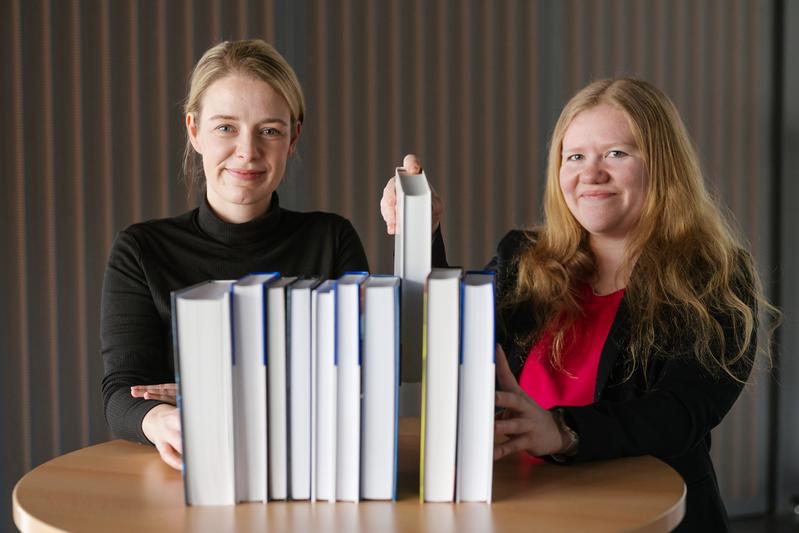
To curb AI's hunger for energy and conserve resources, the team relies on smaller, more purpose-built AI models. Today, AI uses vast data models. A chatbot, for example, uses the complete data model with trillions of parameters for its answer: figuratively speaking, it searches an entire library instead of just the books with relevant content. The researchers have therefore developed AI models in which non-essential parameters are not processed in the first place and which are consequently more economical.
To do this, they filter the knowledge actually needed for the respective task out of large teacher models and create tailored student models that are up to 90 percent smaller. "We are achieving good results by compressing AI models, that is, by making them smaller and more efficient. In our test runs we were able to show that the student models deliver comparable performance but require up to 89 percent less energy," says Sabine Janzen, a senior researcher in Wolfgang Maaß's team. The leaner AI models assembled for the specific use case work without a large infrastructure. "This makes high-performance AI models accessible to small and medium-sized enterprises as well, which was previously impossible simply because of the size of the models," says Janzen.
Automatically finding the best AI model – with 40 percent less energy
For AI models that process and generate digital image data, the researchers use a different method known as "neural architecture search." Here, the procedure automatically finds the best architecture for artificial neural networks. The team was able to show that it can shrink the models by almost 90 percent and reduce energy consumption by 40 percent. In doing so, the models do not lose any performance at all. "With this approach we were even able to improve the accuracy of the model," says Sabine Janzen.
In machine learning with artificial neural networks, the learning processes run in a similar way to those in the human brain. While the human brain is a master of energy efficiency – it has been continuously optimized over the course of evolution and processes information very efficiently – its artificial counterpart requires an enormous amount of computing power and electricity despite its efficient algorithms: artificial neural networks are still laboriously assembled by humans today and adjusted until they deliver good results. "We are automating this process with neural architecture search. In doing so, we test different network structures and optimize them further, so that the models are powerful and efficient but cost less," Sabine Janzen explains.
Test case: scrap sorting
Among others, the team tested its AI models in cooperation with SHS – Stahl-Holding-Saar. The goal here is an AI model that automatically sorts scrap steel and uses camera images to identify which type of scrap steel is being delivered to the plant site. With conventional methods, such a model would be gigantic, energy intensive and not suitable for practical use. The research team compressed the visual AI model for scrap sorting to such an extent that it works compactly, energy efficiently and in some respects even more effectively, and can make the steel recycling process more efficient. To achieve this, they first trained their model with the complete data package and all information, and then compressed the AI models through knowledge distillation and automatically assembled neural networks.
Further savings potential for sustainable data centers
Beyond this, the consortium shows savings potential for data centers. Together with its partners, the Saarbrücken research team developed a concept and recommendations for action for energy-efficient AI, with which data centers and AI users can plan better and identify uneconomical processes. For this purpose, the team developed a tool that enables reliable forecasts of the exact energy consumption and costs of AI models. "This tool makes it possible, for example, to schedule processes that require large amounts of computing power for times when the price of electricity is low. Until now, decision-makers have found it difficult to estimate how much energy they will consume for which models, which makes economic planning difficult," explains doctoral researcher Hannah Stein, who conducts research on energy-saving AI methods.
Neuromorphic chip technologies
In addition, the research consortium is working in the hardware domain on neuromorphic chip technologies – microprocessors that likewise emulate the way the human brain works. "Our results in this hardware area indicate that this technology also works considerably more energy efficiently than conventional chips: in our tests they already run up to six times more efficiently. But further research is needed here, and for that we still need more time," Sabine Janzen explains.
Background
The ESCADE project (Energy-Efficient Large-Scale Artificial Intelligence for Sustainable Data Centers) was funded by Bundesministerium für Forschung, Technologie und Raumfahrt within the "GreenTech Innovation Competition" with around five million euros over a period of three years.
In addition to the research team of Professor Wolfgang Maaß as coordinator (German Research Center for Artificial Intelligence DFKI and Saarland University), the project consortium comprises Dresden University of Technology, Bielefeld University, the data center Rechenzentrum Mitteldeutschland NT Neue Technologie AG (NT.AG), SHS – Stahl-Holding-Saar GmbH & Co. KGaA, SEITEC GmbH, the Austrian research organization Salzburg Research, and the subcontractors eco2050 Institut für Nachhaltigkeit, SpiNNcloud Systems GmbH and elevait GmbH & Co. KG.
The project executing organization is the German Aerospace Center (DLR).