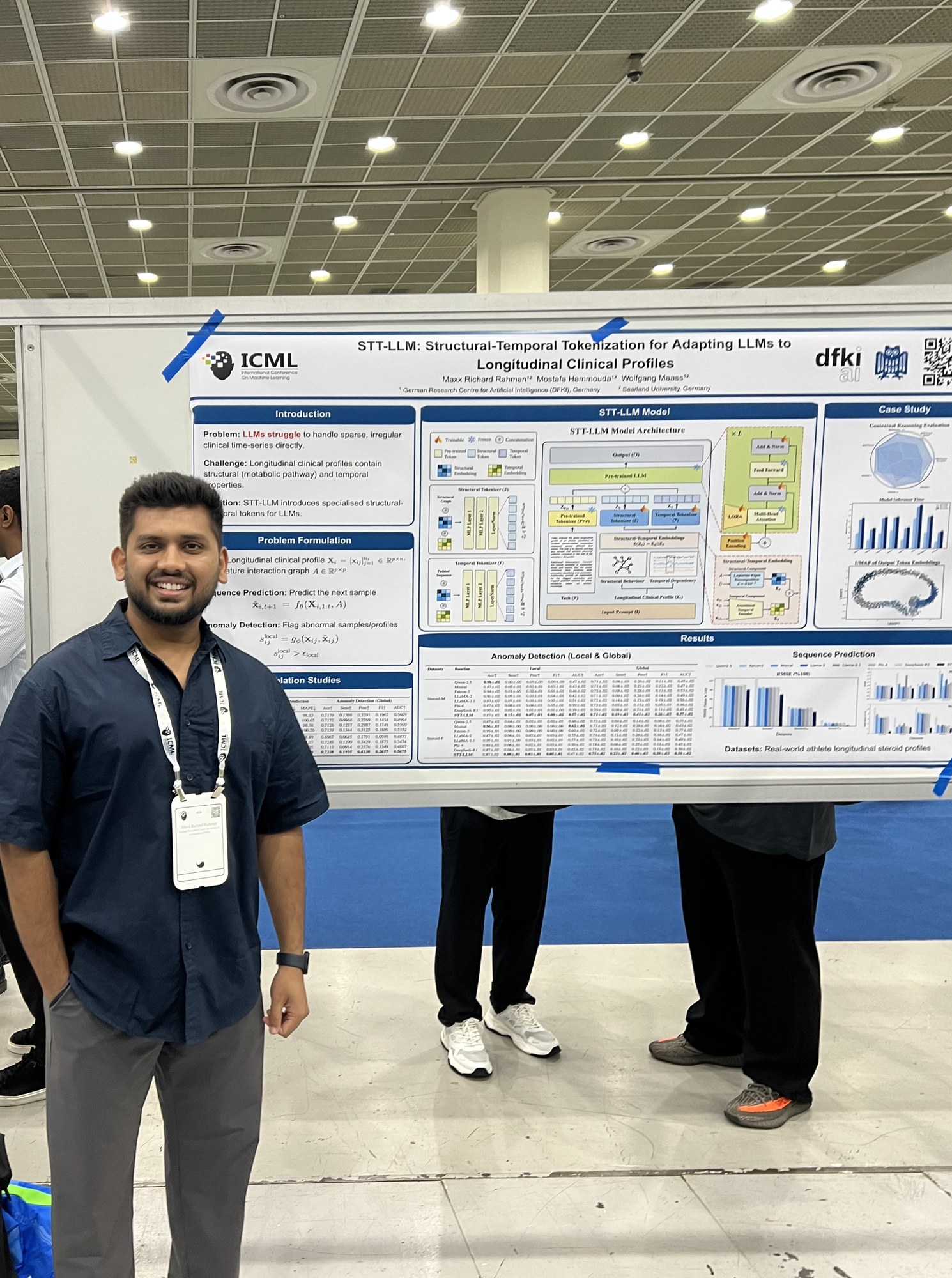
Maxx Richard Rahman presented our research paper (Main Track) at the 43rd International Conference on Machine Learning (ICML) 2026, Seoul, South Korea. The paper titled "STT-LLM: Structural-Temporal Tokenization for Adapting LLMs to Longitudinal Clinical Profiles," introduce STT-LLM, a structural-temporal tokenization framework designed to adapt Large Language Models to longitudinal clinical analysis without modifying their backbone architectures. While LLMs have demonstrated strong generalization capabilities across natural language tasks, their application to longitudinal clinical profiles remains challenging due to the complex temporal dynamics and biological relationships within medical data. STT-LLM addresses this challenge by constructing biologically grounded structural-temporal embeddings and transforming them into LLM-compatible tokens through a specialized token evolution mechanism. The proposed framework is evaluated on real-world longitudinal athlete datasets, where biological profiles are analyzed to support the early detection of prohibited substance use and anomalous clinical patterns. The results show consistent improvements over native LLM tokenization strategies in sequence prediction and anomaly detection tasks. In addition, the study demonstrates that STT-LLM can provide contextual reasoning that aligns more closely with expert assessments compared to baseline models. This acceptance highlights the importance of tokenization as a key bottleneck and opportunity for adapting LLMs to complex clinical time-series data. The work contributes to the growing field of trustworthy and domain-aware AI systems for longitudinal clinical decision support.
Reference:
Rahman, M. R., Hammouda, M., & Maass, W. (2026). STT-LLM: Structural-Temporal Tokenization for Adapting LLMs to Longitudinal Clinical Profiles. In Proceedings of the 43rd International Conference on Machine Learning (ICML 2026), South Korea.
Contact:
Maxx Richard Rahman – maxx_richard.rahman@dfki.de