
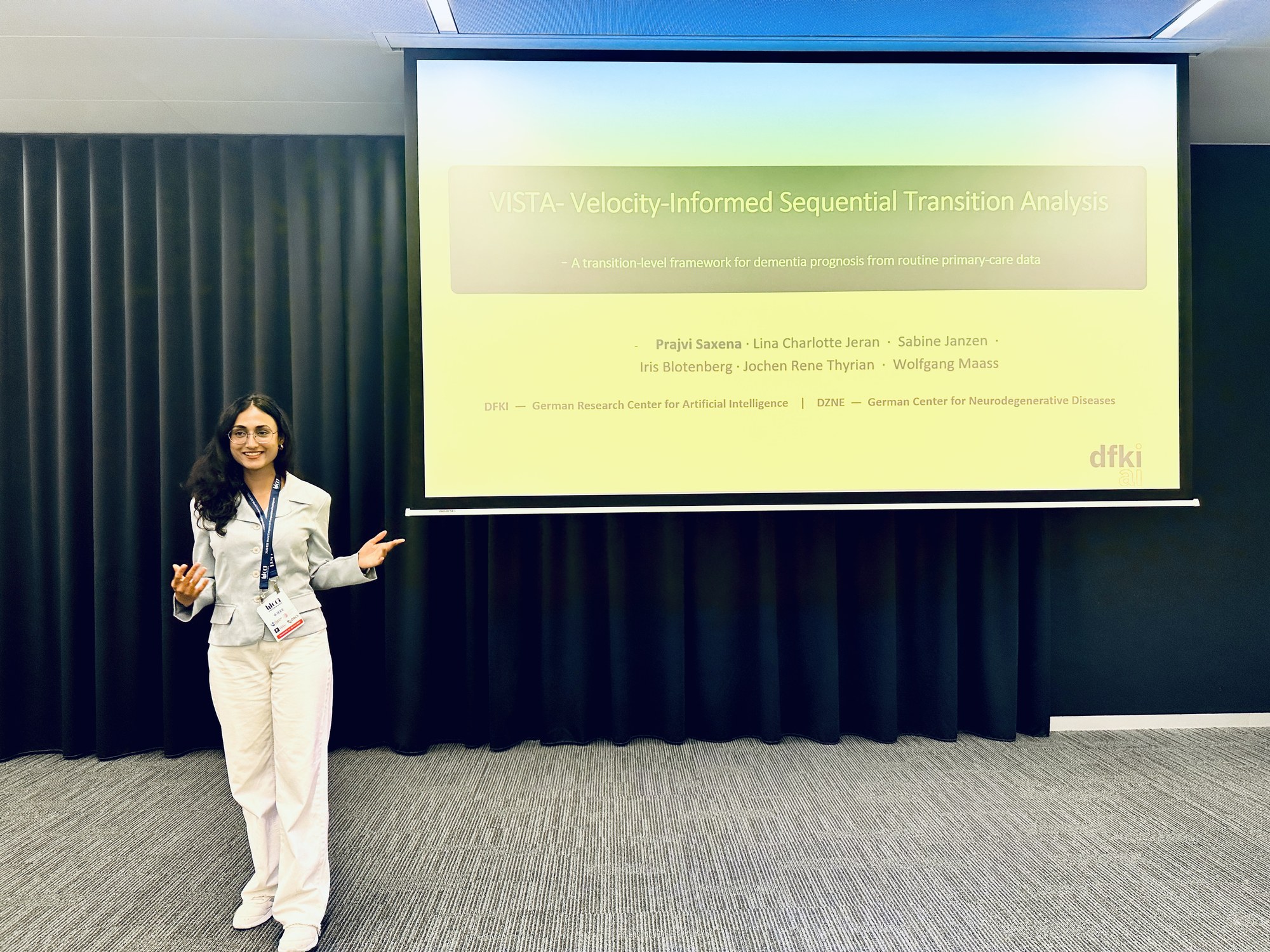
We are pleased to share that our paper, "VISTA: Velocity-Informed Sequential Transition Analysis," was presented as an oral presentation at the International Joint Conference on Neural Networks (IJCNN) 2026, part of the IEEE World Congress on Computational Intelligence (WCCI) in Maastricht, the Netherlands.
VISTA is a machine learning framework for dementia prognosis developed in collaboration between the German Research Center for Artificial Intelligence (DFKI) and the German Center for Neurodegenerative Diseases (DZNE). The work addresses a key limitation in existing prognostic approaches, which typically treat patient assessments as independent snapshots and overlook the rate of change in a patient's condition over time. VISTA explicitly encodes this temporal velocity alongside absolute clinical state, decomposing patient histories into sequential transition-level segments via a sliding-window approach. Evaluated on the DelpHi dataset, an 8-year longitudinal cohort of 459 older adults from primary care in Mecklenburg-Western Pomerania, Germany.
The presentation drew strong engagement from the IJCNN community, with detailed questions on model interpretability, clinical applicability, and extending the approach to broader neurodegenerative cohorts. Beyond the session itself, IJCNN 2026 offered valuable opportunities to connect with researchers across the neural networks and computational intelligence community, including discussions on reinforcement learning. This work reinforces that accurate dementia prognosis is achievable from low-cost, routinely collected clinical assessments, without the need for expensive neuroimaging or genetic biomarkers, supporting scalable deployment in primary care settings.
Reference:
Saxena, P., Jeran, L. C., Janzen, S., Blotenberg, I., Thyrian, J. R., & Maaß, W. (2026). VISTA: Velocity-informed sequential transition analysis. In 2026 International Joint Conference on Neural Networks (IJCNN). IEEE World Congress on Computational Intelligence.
Contact:
Prajvi Saxena – prajvi.saxena@dfki.de