
News Article January 26, 2026
Award Deep Learning Health AI

Best Paper Presentation Award at AAAI Workshop 2026

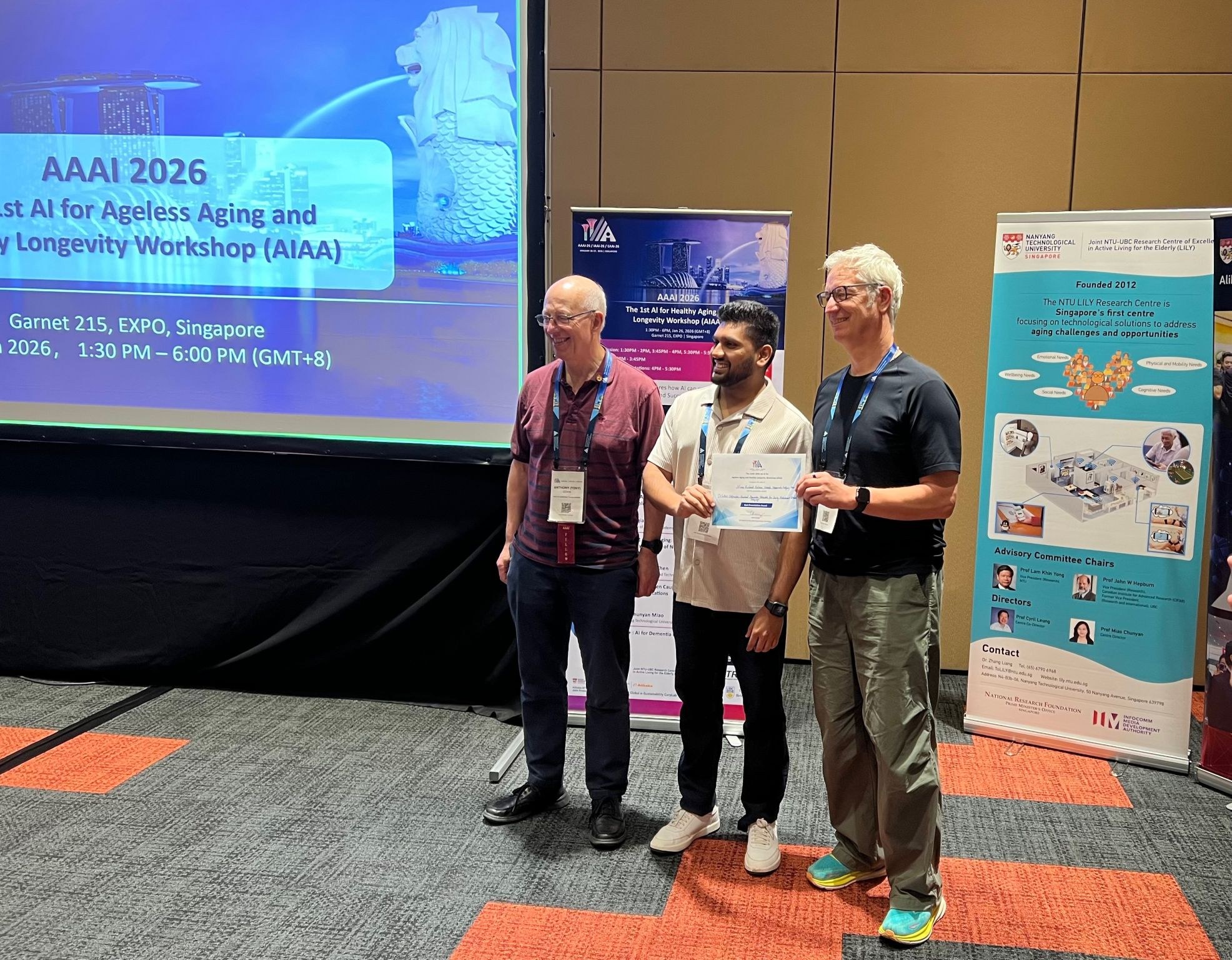
Our paper "DiGAN: Diffusion-Guided Attention Network for Early Alzheimer's Disease Detection" received the Best Paper Presentation Award at the 1st AI for Healthy Aging and Longevity Workshop (AIAA) at AAAI 2026 in Singapore.

Best Paper Presentation Award at AAAI Workshop 2026

We are happy to announce that our paper, "DiGAN: Diffusion-Guided Attention Network for Early Alzheimer's Disease Detection," received the Best Paper Presentation Award at the 1st AI for Healthy Aging and Longevity Workshop (AIAA), held at the 40th Annual AAAI Conference on Artificial Intelligence (AAAI 2026) in Singapore. In this work, we introduce DiGAN, a novel deep learning architecture that integrates diffusion models with attention mechanisms to capture subtle and complex neurodegenerative patterns associated with early-stage Alzheimer's disease. By leveraging diffusion-based representation learning to improve data quality and attention-driven feature selection to focus on the most diagnostically relevant biomarkers, the proposed framework improves sensitivity and robustness in early detection scenarios where changes are often minimal and difficult to identify. The award recognizes both the scientific contribution of the method and the clarity of its presentation, advancing AI-driven healthcare solutions that address critical challenges in aging and longevity.


Reference:

Rahman, M. R., Hammouda, M., & Maass, W. (2026). DiGAN: Diffusion-Guided Attention Network for Early Alzheimer's Disease Detection. In 1st AI for Healthy Aging and Longevity Workshop (AIAA): 40th Annual AAAI Conference on Artificial Intelligence (AAAI 2026), Singapore.


Contact:
Maxx Richard Rahman – maxx_richard.rahman@dfki.de

Additional Resources

AAAI-26, Singapore

https://aaai.org/conference/aaai/aaai-26/

Other News

ESCADE Closing Event: Three Years of Research on Energy-Efficient AI

On 30 July 2026, more than 50 guests from research, industry and public administration came to DFKI Saarbrücken for the closing event of the ESCADE project. After three years, the consortium coordinated by Prof. Wolfgang Maaß presented how the energy demand of AI can be reduced by up to 90 percent – and drew wide media attention in the days around the event.

Read More →

ESCADE in the Frankfurter Allgemeine Zeitung

The Frankfurter Allgemeine Zeitung reported on the results of the ESCADE project, placing the consortium's efficiency gains in the wider context of the global data center buildout.

Read More →

How AI Becomes Significantly More Energy Efficient – Press Coverage of the ESCADE Results

Ahead of the closing event of the ESCADE project, Saarland University issued a press release on the results of the research consortium led by Prof. Wolfgang Maaß: how the electricity demand of AI can be cut by up to 90 percent through smaller models, automated network design and neuromorphic hardware.

Read More →