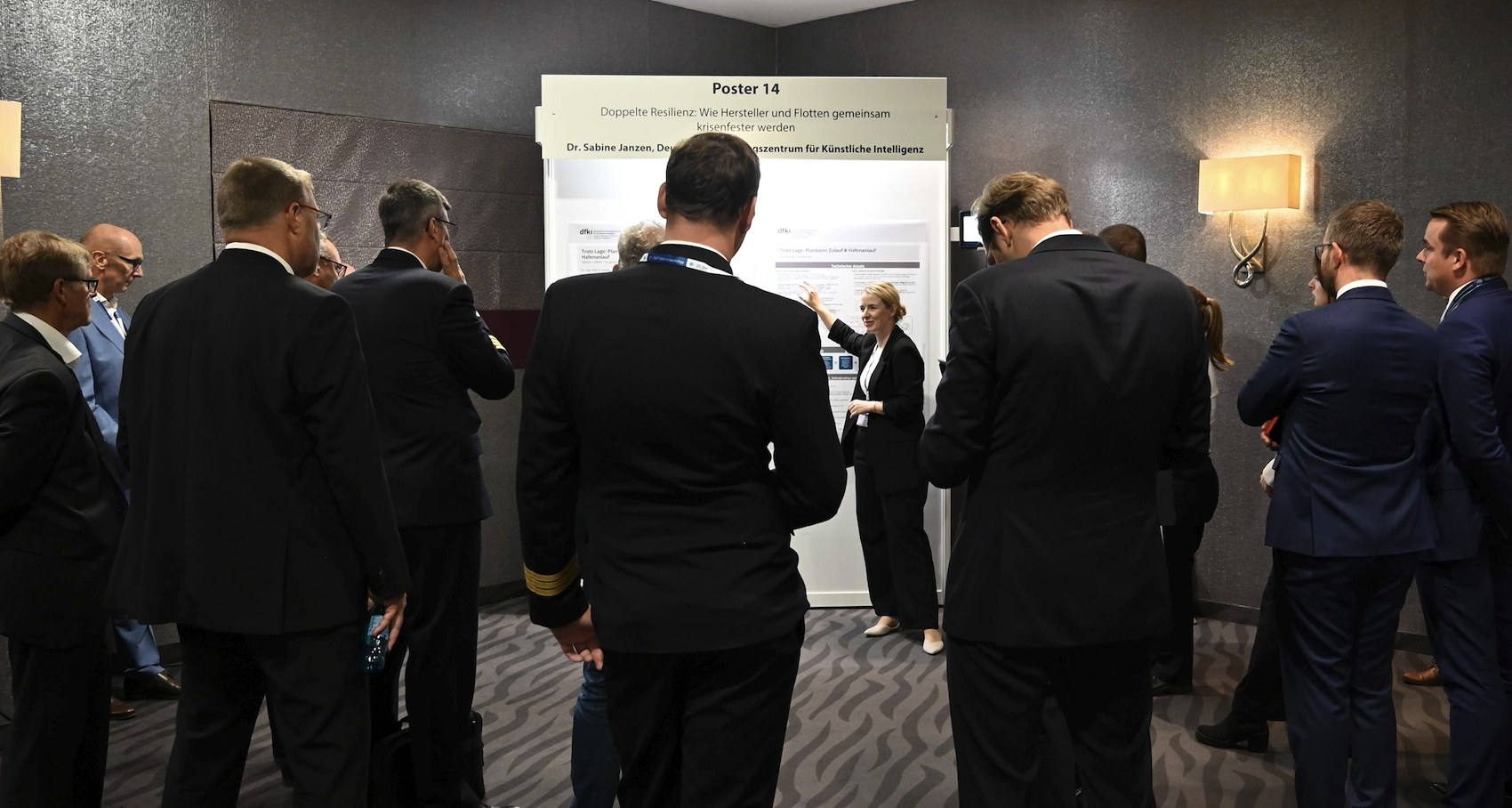
At this year's DWT Marine Workshop in Linstow, DFKI was represented with a contribution by Dr.-Ing. Sabine Janzen from the Smart Service Engineering research department. Under the title „Trotz Lage: Planbarer Zulauf & Hafenanlauf" (Despite the situation: predictable approach and port call), an AI-based solution for robust approach control and port logistics was presented. The focus was on the ARGUS and ROMY approaches, which analyze, fuse and prioritize multimodal data, ranging from weather and water level information to sensor data and social media reports. The aim was to enable predictable and safe approaches even under difficult conditions such as storm surges, GNSS interference or heavy traffic loads. With this contribution, DFKI was able to demonstrate its expertise in AI-supported decision support for maritime logistics and military mobility and to provide valuable impulses for the exchange between research, industry and the German Armed Forces.
AI for Maritime Logistics at the 27th DWT Marine Workshop 2025
At the 27th DWT Marine Workshop in Linstow, Dr.-Ing. Sabine Janzen presented an AI-based approach to robust approach control and port logistics, built on the ARGUS and ROMY systems for analyzing, fusing and prioritizing multimodal data.
Additional Resources
Share this article
Other News
ESCADE Closing Event: Three Years of Research on Energy-Efficient AI
On 30 July 2026, more than 50 guests from research, industry and public administration came to DFKI Saarbrücken for the closing event of the ESCADE project. After three years, the consortium coordinated by Prof. Wolfgang Maaß presented how the energy demand of AI can be reduced by up to 90 percent – and drew wide media attention in the days around the event.
Read More →How AI Becomes Significantly More Energy Efficient – Press Coverage of the ESCADE Results
Ahead of the closing event of the ESCADE project, Saarland University issued a press release on the results of the research consortium led by Prof. Wolfgang Maaß: how the electricity demand of AI can be cut by up to 90 percent through smaller models, automated network design and neuromorphic hardware.
Read More →Paper Presentation at ICML 2026
Maxx Richard Rahman presented STT-LLM, a structural-temporal tokenization framework for adapting Large Language Models to longitudinal clinical profiles, in the Main Track of ICML 2026 in Seoul.
Read More →