

PathFold - Language Modelling for Protein (Mis-)Folding Pathway Dynamics
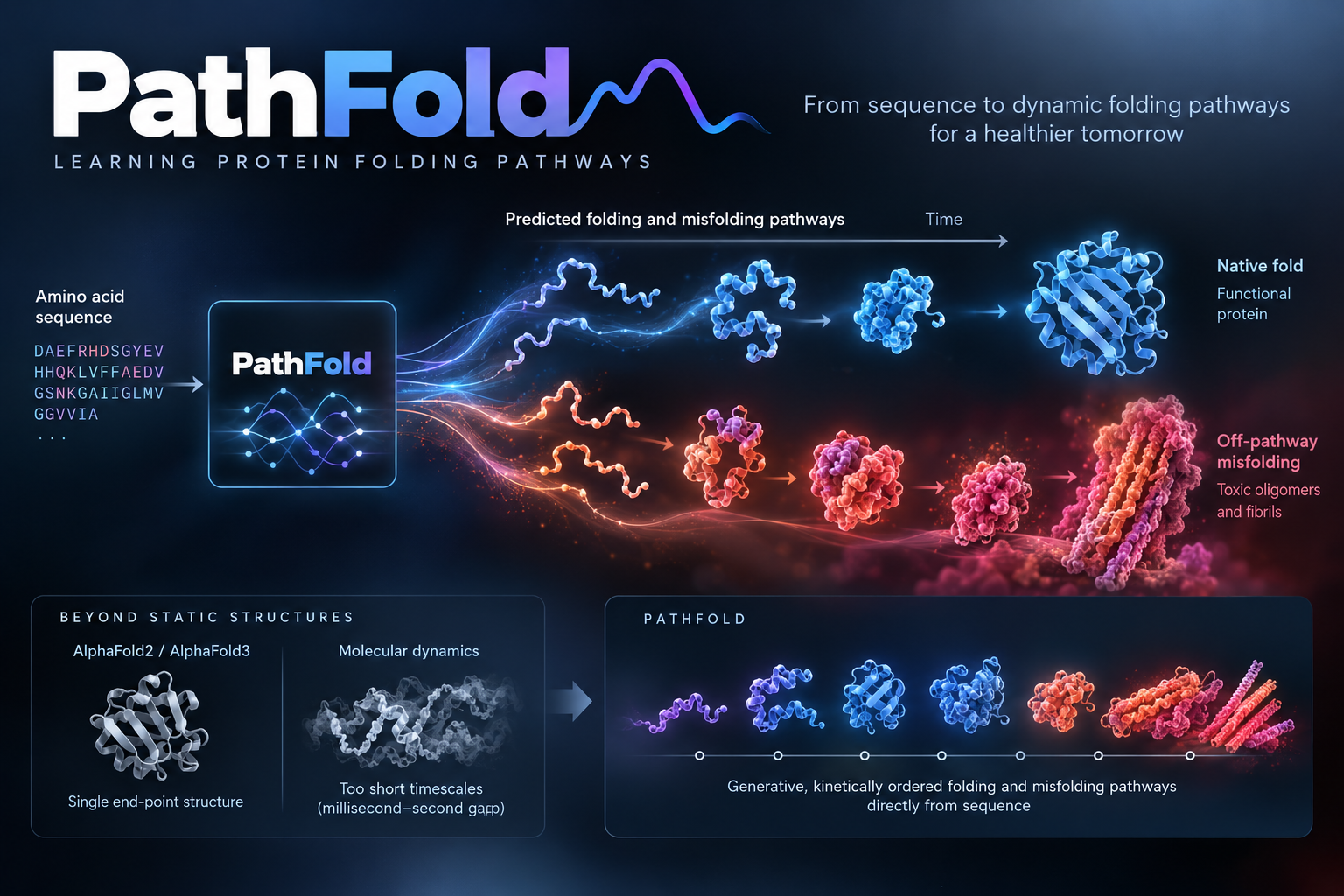
Protein folding determines whether a polypeptide chain reaches its native, functional conformation or diverges into a structurally aberrant state that causes disease. In amyloid-forming proteins such as amyloid-beta, tau and alpha-synuclein, early off-pathway conformations initiate the nucleation and propagation of toxic oligomeric aggregates years or decades before neuronal damage becomes clinically detectable. Despite transformative progress in static structure prediction, this dynamic dimension of protein biology remains computationally inaccessible at scale: AlphaFold2 and AlphaFold3 describe only the folding endpoint, while molecular dynamics simulations cannot reach the millisecond-to-second timescales on which clinically relevant folding and misfolding events occur. PathFold addresses this gap by developing a generative framework that learns and predicts how proteins fold and misfold over time directly from their amino acid sequences. Rather than predicting a single final structure, PathFold models folding as a coarse-grained, kinetically ordered sequence of structural transitions, capturing the order, timing and interdependence of the conformational events that govern stability.
Project Timeline
Other Projects
FedWell – Life-Long Federated User and Mental Modeling for Health and Well-being
Adaptive and personalized AI systems in healthcare rely on user and situational data to provide...
Learn MoreCircularSaar – Circular Economy Strategies for Saarland Industries
The CircularSaar project supports Saarland's transition towards a sustainable circular economy...
Learn More